
During an EngCon technical session in December 2025, PIDtoExcel outlined its approach for achieving fully verified P&ID digitization outcomes with complete accuracy and coverage, using a structured hybrid workflow.
The presentation explained that accuracy at this level is not the result of automation alone, but of a controlled combination of AI-driven digitization and disciplined human review, designed specifically for engineering-grade deliverables.
In the context of P&ID digitization, “100% verified” does not refer to model confidence or automated accuracy metrics. It refers to the state of the final deliverable.
Every digitized element—equipment tags, line numbers, instruments, and associated metadata—is reviewed, validated, and finalized before delivery. This ensures that the output is complete, internally consistent, and suitable for downstream engineering, estimation, and audit workflows.
In other words, verification is a workflow guarantee, not an AI claim.
PIDtoExcel employs sophisticated digitization methods, including computer vision, machine learning, and artificial intelligence, to automate approximately 80% of the digitization effort, covering the bulk of symbols, tags, and structures in typical P&IDs.
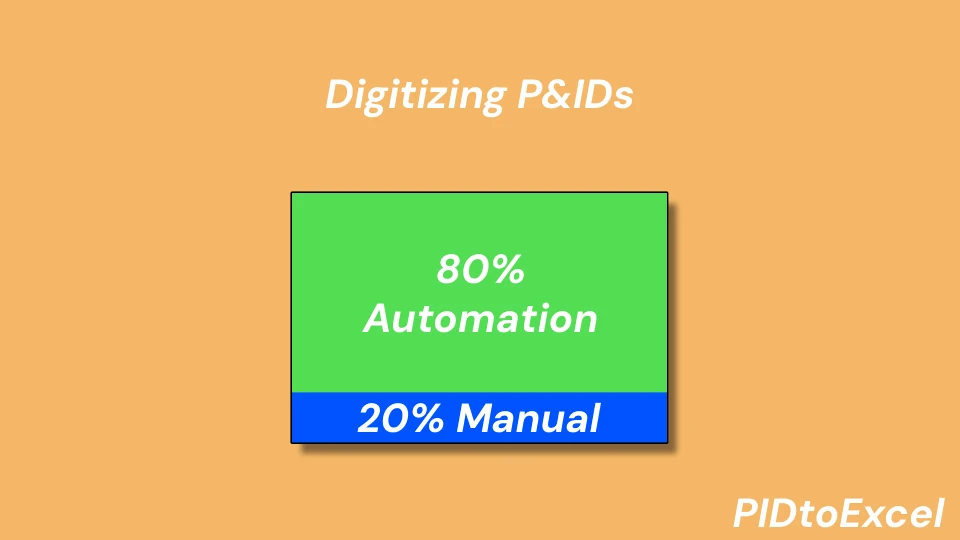
The remaining 20% is handled through a guided human review process, where trained engineers validate, correct, and complete the digitized data using purpose-built tools, with all changes traceable and reviewable. This step addresses edge cases, drawing inconsistencies, and contextual ambiguities that remain outside the reach of fully automated methods.
This final review stage ensures that the delivered output — not the raw AI result — achieves 100% accuracy and coverage, suitable for downstream engineering, estimation, and audit use.
Across typical P&ID sets, automated digitization performs well on standardized symbols, consistent tagging patterns, and clean drawing layouts. However, real-world drawings often contain ambiguities—hand edits, overlapping elements, legacy symbols, and inconsistent annotations.
These edge cases are precisely where fully automated approaches struggle. Rather than forcing AI to guess, the hybrid workflow intentionally routes these cases to human review, where engineering judgment resolves ambiguity without compromising accuracy.
The result is a system that prioritizes correctness over automation completeness.
More details on the workflow and supporting tools are available at pidtoexcel.com.